Safe Link Velocity Rules for New Websites
Long-term search visibility isn’t built through a single tactic—it’s the result of a well-planned authority strategy. If you want to understand how this topic fits into the complete SEO ecosystem, start with our Organic Authority Optimization Scaling Engine: Complete Guide 2026, then continue with the insights below.
Your new website just launched. You want backlinks — fast. But building links too quickly can trigger Google’s spam filters and tank a site that hasn’t even had a chance to rank yet. Safe link building velocity for new websites isn’t just a best practice. It’s the difference between sustainable organic growth and a manual penalty that takes months to recover from.
Founders, SaaS marketers, affiliate operators, and e-commerce store owners all face this same pressure — rank fast, generate revenue, prove ROI. The temptation to shortcut the process is real. But the rules of safe link acquisition for newer domains are different, stricter, and more unforgiving than most people realize.
This guide breaks it all down.
Table of Contents
- What Is Link Building Velocity and Why It Matters
- How Google Detects Unnatural Link Patterns
- Safe Link Velocity Benchmarks for New Websites
- Types of Links That Signal Trust vs. Danger
- A Month-by-Month Link Acquisition Framework
- Tools and Techniques to Monitor Your Velocity
- How to Scale Without Triggering Penalties
- Conclusion
What Is Link Velocity and Why It Matters
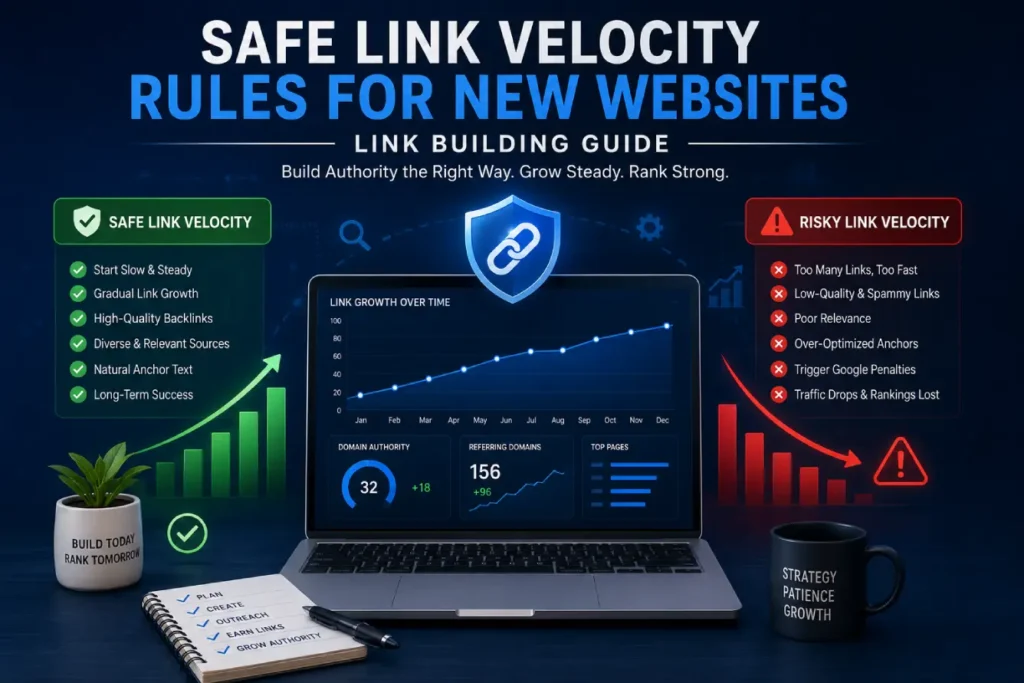
Link velocity is the rate at which a website acquires backlinks over time. Think of it like a heart rate monitor — a steady rhythm signals health, while sudden spikes raise alarms. For a brand-new website, Google expects gradual link growth that mirrors organic discovery.
A site that jumps from zero to 300 backlinks in its first two weeks looks suspicious. But a site that earns 5 to 15 quality links per month over six months?
That looks natural. Google’s algorithms — especially Penguin, which is now baked into the core algorithm — continuously evaluate link patterns, not just individual links.
Why does this matter to founders and marketers? Because an unnatural link spike can suppress rankings before you’ve even established a baseline.
A 2023 study by Semrush found that sites with erratic early link growth took 40% longer to achieve stable first-page rankings than sites with steady acquisition patterns.
So the question isn’t just “how many links?” It’s “at what pace?”
—
For businesses that want to improve rankings without relying on risky tactics, our Niche Edits vs Guest Post: The Winning Link Building Strategy for 2026 offers a structured framework based on sustainable SEO practices.
How Google Detects Unnatural Link Patterns
Google doesn’t just count links. It analyzes patterns, anchor text ratios, source diversity, and timing intervals between link acquisitions. And it’s very good at spotting anomalies.
Red flags include: A sudden burst of 50+ links within days of a site launch
- Over-optimized anchor text (e.g., 60% exact-match commercial anchors)
- Links exclusively from the same niche, country, or domain type
- Zero link growth, then a spike, then zero again
- Conduct a competitor backlink analysis to see what a healthy link profile looks like in your specific industry. Your competitors reveal the natural velocity curve you should aim to mirror — not exceed overnight.
Ahrefs data shows that the average new SaaS website earns between 3 and 20 referring domains per month in its first year.
So Google isn’t just checking if you have links. It’s checking if you deserve the links you’ve got.
Safe Link Velocity Benchmarks for New Websites
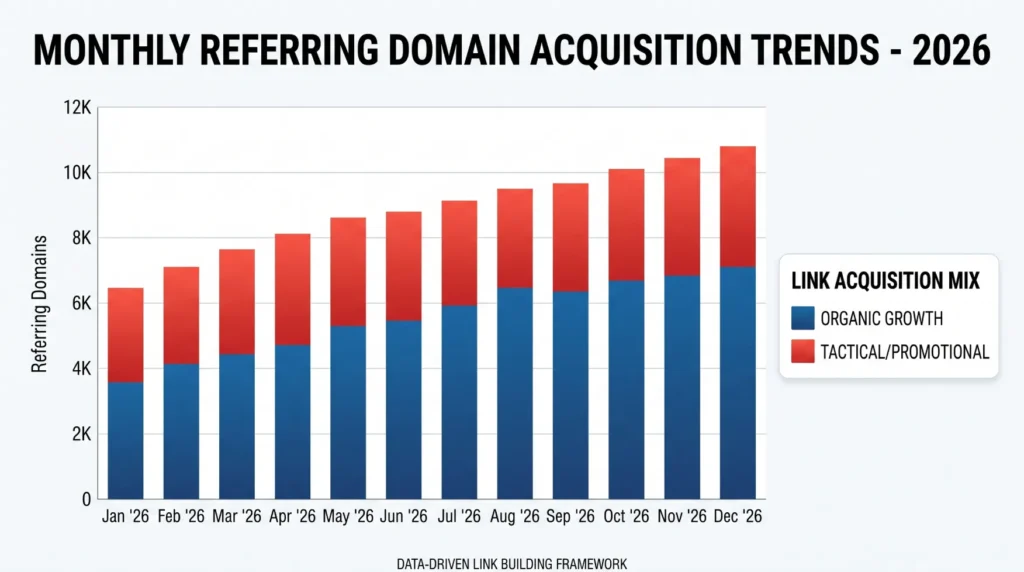
What’s actually safe? Here are realistic, data-backed benchmarks for safe link building velocity for new websites:
- Months 1–2: 0–5 links per month (directories, citations, brand mentions)
- Months 3–4: 5–15 links per month (guest posts, niche edits, PR links)
- Months 5–6: 15–30 links per month (scaled outreach, editorial mentions)
- Months 7–12: 30–60 links per month (authority building, digital PR)
These aren’t rigid rules. They’re guardrails. A new e-commerce store for pet supplies in Australia will have different competitive benchmarks than a B2B SaaS company targeting U.S. enterprise buyers.
Understand the difference between niche edits vs guest posting and how each contributes to velocity in a way that looks editorial, not manufactured.
This is only one part of a successful SEO strategy. For a deeper understanding, read our Competitor Backlink Gap Analysis | Find & Win Hidden Link Opportunities, which explains the complete process in detail.
Types of Links That Signal Trust vs. Danger
Not all links are created equal. And link type diversity is a key velocity signal.
Trust-building link types:
- Editorial mentions from industry publications (e.g., getting cited in a Forbes or TechCrunch roundup)
- HARO (Help a Reporter Out) response links
- Niche-relevant directory listings
- Digital PR mentions from news events
- Dangerous link types (especially early on):Bulk private blog network (PBN) links
- Links from foreign-language spam sites
- Reciprocal link schemes with unrelated domains
- Fiverr-style “1000 backlinks for $5” packages
New websites have thin link history, which means Google has less context to evaluate quality. A single spammy link can carry disproportionate negative weight early on. Know how to how to audit clean backlinks regularly, especially after any outsourced link building campaign.
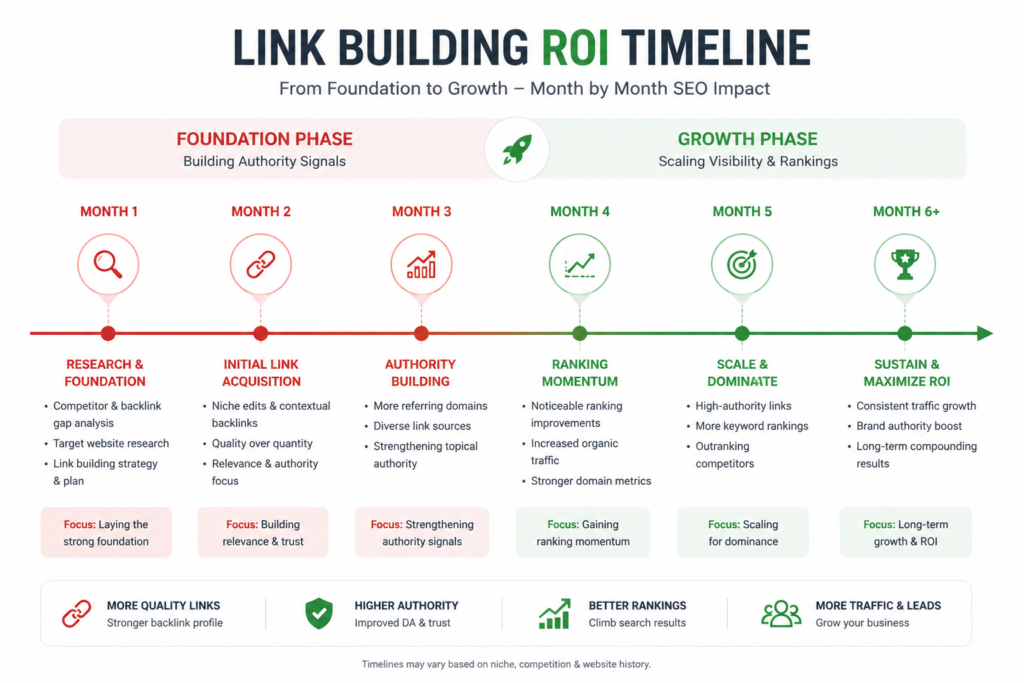
A Month-by-Month Link Acquisition Framework
Here’s a practical framework built for new domains:
- Month 1: Foundation Phase
Start with brand mentions, NAP citations (Name, Address, Phone), and social profile links. These are low-risk, expected signals for any new business. Don’t buy anything yet.
- Month 2–3: Content and Relationships
Publish two to four in-depth content pieces. Reach out to bloggers and journalists for commentary. Submit to curated directories like Clutch (for B2B) or G2. Earn your first three to eight editorial links.
- Month 4–6: Outreach at Scale
Introduce structured guest posting and niche edits. Vary your anchor text: 60% branded, 20% generic (“click here,” “learn more”), and only 10–15% exact-match keywords. This ratio matters enormously.
- Month 7–12: Authority Amplification
Now you can scale. Launch digital PR campaigns, pursue podcast appearances, and build resource links. Your domain has enough history that Google trusts a faster acquisition rate.
To explore this topic in greater depth, check out our Identifying and Avoiding Spammy Link Networks | How to Audit Clean Backlinks resource, where you’ll find practical strategies, expert insights, and actionable recommendations.
Tools and Techniques to Monitor Your Velocity
You can’t manage what you don’t measure. Several tools help track backlink profiles safely over time:
- Ahrefs: Shows referring domain growth graphs with date-stamped acquisition curves
- Google Search Console: Free, first-party data on links Google has indexed
- Semrush Backlink Audit Tool: Flags toxic links and velocity anomalies
- Majestic: Historical trust flow and citation flow trends
Set up monthly reporting. Export your referring domain count on the first of each month. If you spot a spike you didn’t initiate, investigate immediately — negative SEO attacks are real and can affect new sites disproportionately.
Also explore link building techniques that focus on editorial acquisition rather than manufactured volume. Quality control is more important than quantity in the first 12 months.
How to Scale Without Triggering Penalties
Scaling link velocity safely comes down to three principles: diversity, consistency, and patience.
Diversity means acquiring links from different domain types, countries, and content formats. Don’t get all your links from guest posts alone. Consistency means building month-over-month at a predictable rate — no gaps, no explosive jumps. And patience? That’s the hardest one for founders watching competitors rank above them.
But here’s the truth: Google rewards compounding authority. A site that earns 15 quality links per month for 12 months will typically outrank a site that bought 500 links in one campaign — and got away with it temporarily.
Use link building techniques that produce editorial signals: data-driven content, proprietary research, and genuine relationship-based outreach. These create links competitors can’t easily replicate.
—
If you’d rather have experts handle this process for you, our Modern Anchor Text Optimization Blueprint | Rank Smarter in 2026 provides a proven, white-hat approach designed to deliver sustainable long-term results.
Final Thoughts: Grow Smart, Not Just Fast
Safe link building velocity for new websites comes down to this: earn links at a pace that mirrors organic discovery, diversify your sources, and never let impatience turn a promising site into a penalty case.
Three core takeaways:
- Start slow. Months one and two are for foundations — not bulk acquisition campaigns.
- Monitor monthly. Use Ahrefs or Search Console to track referring domain growth consistently.
- Diversify always. Link type, anchor text, and source variety protect your site from algorithmic scrutiny.
Your new website deserves a link profile that supports long-term rankings — not one that triggers a review. Ready to build authority the right way?
Order our Premium Link Building Service Now and let our experts design a link velocity strategy tailored to your domain age, industry, and growth targets.
Building lasting organic visibility requires the right strategy, consistent execution, and a focus on quality over shortcuts. The resources below will help you take the next step.
FAQ
1. What are spammy links, and why are they dangerous for new websites?
Spammy links are low-quality or manipulative backlinks created solely to influence search rankings. For new websites, earning too many spammy links early can reduce trust signals, limit ranking potential, and increase the risk of algorithmic actions.
2. How can I identify spammy links pointing to my website?
Look for backlinks from irrelevant websites, link farms, hacked pages, private blog networks (PBNs), auto-generated content, or domains with little editorial value. Regular backlink audits help you detect spammy links before they become a bigger SEO problem.
3. Can spammy links cause a Google penalty?
Yes. While Google ignores many low-quality backlinks automatically, a backlink profile heavily dominated by spammy links can negatively impact your site’s authority and, in some cases, contribute to manual or algorithmic penalties.
4. What is the safest way to avoid spammy links when building backlinks?
Focus on earning editorial links from relevant, authoritative websites through valuable content, digital PR, guest posting on trusted publications, and genuine industry relationships. Avoid buying bulk backlinks or participating in link schemes that generate spammy links.
5. If my website already has spammy links, what should I do?
Start by auditing your backlink profile, identify harmful or irrelevant backlinks, request removal where possible, and use Google’s Disavow Tool only when necessary. Replacing spammy links with high-quality, relevant backlinks is the best long-term strategy for improving domain authority and sustainable rankings.