Which Strategy Actually Wins in 2026?
Choosing the right link-building strategy is no longer about acquiring the most backlinks—it’s about building the right authority signals that search engines trust. Understanding how authority optimization shapes rankings, relevance, and long-term organic growth provides the foundation for making smarter SEO decisions.
With that context in mind, let’s look at how one SaaS founder transformed his search performance by choosing the right approach.
Niche Edits vs Guest Post: Marcus ran a SaaS analytics tool out of Austin, Texas. His domain authority sat at 28. Competitors were ranking on page one for every keyword he’d spent six months targeting.
He’d tried everything — cold outreach, directory submissions, even paid press releases.
Then his SEO consultant handed him a simple question: “Are you building links the right way, or just building links?”
That question changed how Marcus approached his entire niche edits vs guest post decision — and within five months, his organic traffic jumped 214%. This article unpacks what he learned, why it matters for your business in 2026, and how you can replicate his results without wasting another dollar on low-ROI tactics.
Table of Contents
- The Setup: Understanding Both Strategies
- Niche Edits Explained — and Why They Work
- Guest Posting in 2026 — Still Alive or on Life Support?
- Niche Edits vs Guest Post: The Head-to-Head Breakdown
- When to Use Free Guest Posting Sites (And When Not To)
- How to Build a Link-Building Plan That Combines Both
- The Transformation: What a Smart Link Strategy Actually Looks Like
- Conclusion
1. The Setup: Understanding Both Strategies
Marcus wasn’t alone in his confusion. Most B2B founders and SaaS marketers treat link building like a checklist — post here, submit there, repeat. But link building in 2026 is a precision game, not a volume play.
Niche edits (also called curated links or link insertions) place your URL inside an already-published, indexed article. Guest posts are new articles you write and publish on third-party sites. Both earn you backlinks. But they work in fundamentally different ways — and choosing the wrong one can cost you three to six months of momentum.
The difference matters. Google’s March 2024 core update specifically devalued thin, freshly-published guest post content that lacked topical depth. Sites hit hardest? Those relying on low-authority guest posts as their primary link source.
—
This is only one part of a successful SEO strategy. For a deeper understanding, read our “Safe Link Velocity Rules for New Websites | Link Building Guide“, which explains the complete process in detail.
2. Niche Edits Explained — and Why They Work
Here’s what most people miss about niche edits. A link inserted into a five-year-old article already has trust signals baked in — crawl history, inbound links, and user engagement data.
Why Aged Content Links Hit Harder
Google has already evaluated that page dozens of times. It knows the content is relevant and trustworthy. When your link appears there, it inherits that credibility almost immediately.
A 2023 study by Authority Hacker analyzed 200 niche edit campaigns and found that niche edits produced ranking improvements 43% faster than equivalent guest posts. That’s not a small margin. For e-commerce store owners running seasonal campaigns, speed matters enormously.
And here’s the kicker — niche edits typically cost less time. You’re not writing a 1,000-word article. You’re placing a contextual anchor inside existing content.
Risks You Should Know
Not all niche edits are equal. Links placed in low-traffic, poorly-maintained sites carry almost no value. Always verify the host page’s organic traffic before proceeding — Ahrefs and Semrush both show this clearly.
3. Guest Posting in 2026 — Still Alive or on Life Support?
Guest posting isn’t dead. But it’s changed dramatically. Gone are the days when publishing on any DA30+ blog guaranteed a rankings boost.
What Still Works in Guest Posting
High-authority, editorially selective publications still pass tremendous link equity. Think Entrepreneur.com, HubSpot’s blog, or industry-specific SaaS publications like SaaStr. These sites have real audiences and strict editorial standards. A single link from one of these beats fifty links from content farms.
The strategy that works now is narrow targeting. Pitch only sites your audience actually reads. For affiliate asset owners, that means niche finance blogs, comparison sites, and review portals — not generic “write for us” directories.
According to Semrush’s 2024 Link Building Report, pages with guest posts from high-authority, relevant domains earned 67% more organic traffic within 90 days compared to low-authority placements.
The Quality Trap
Many marketers fall into the trap of chasing volume. They submit to dozens of free guest posting sites to scale quickly. But Google’s spam detection has grown sharp enough to identify patterns of bulk guest posting, especially when anchor texts are over-optimized.
—
Many websites struggle with this exact challenge. Our Modern Anchor Text Optimization Blueprint | Rank Smarter in 2026 explains how to overcome it using proven strategies that align with Google’s best practices.
4. Niche Edits vs Guest Post: The Head-to-Head Breakdown
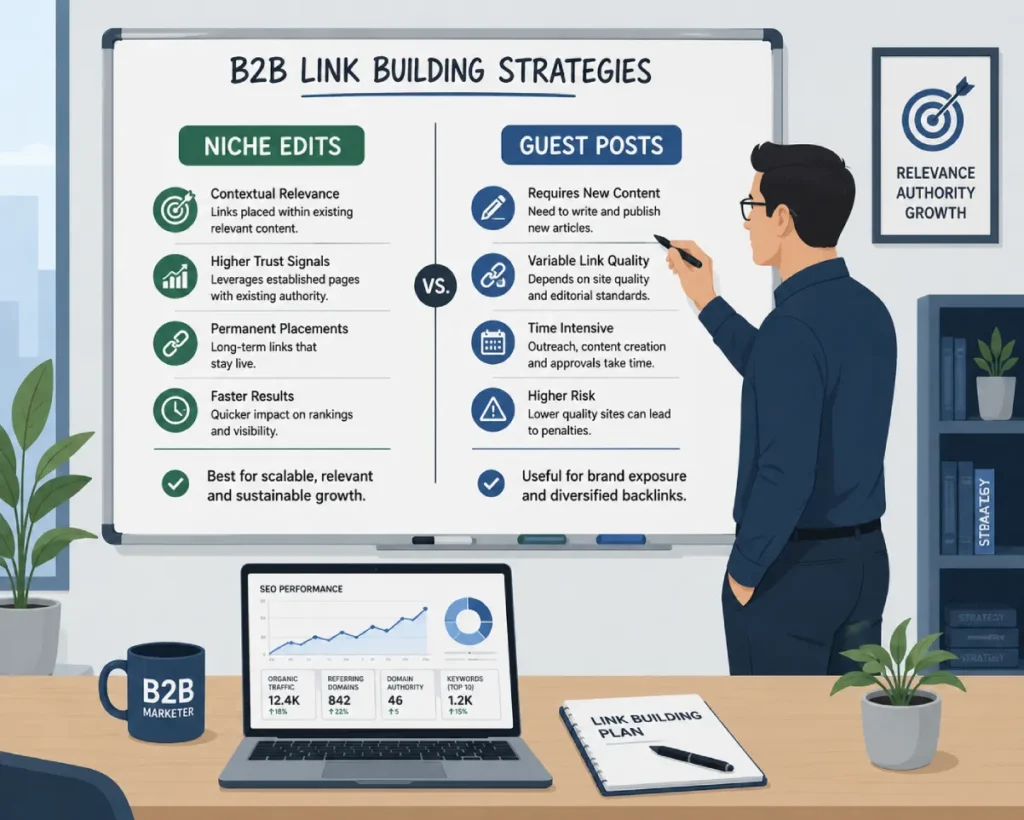
So which wins? The honest answer is — it depends on where you are in your SEO lifecycle.
Early-Stage Sites (Under 6 Months Old)
Guest posts help establish topical authority. Publishing on relevant blogs tells Google what your site is about. New domains benefit from the brand association that comes with being featured in established publications.
Mid-Stage Sites (6–18 Months)
This is where the niche edits vs guest post debate really opens up. Niche edits start delivering faster ROI because your domain already has baseline trust. You’re amplifying existing signals rather than building from scratch.
Mature Sites (18+ Months)
Both strategies work — but niche edits compound faster. A well-placed link in a high-traffic, aged article on a site like Moz or Search Engine Journal can move rankings within weeks. Don’t underestimate the power of a strategic backlink gap analysis to identify exactly where competitors are winning links you’re missing.
5. When to Use Free Guest Posting Sites (And When Not To)
Let’s be honest — not every brand has a $5,000 monthly link building budget. That’s fine. Free options still exist, and some deliver real value.
The key is selectivity. Use free guest posting sites only when they meet these three criteria: genuine editorial standards, niche relevance to your industry, and demonstrated organic traffic of at least 1,000 monthly visits.
Sites like AllBusiness.com or Medium’s niche publications can still work when the content quality is high and the topic is directly relevant. But mass-submission to generic directories? That’s a fast track to a manual penalty.
Use free guest posting as a supplementary tactic, not a primary strategy. Think of it as building reach while your paid link placements do the heavy SEO lifting.
6. How to Build a Link Building Plan That Combines Both
Marcus didn’t pick one strategy. He built a layered approach — and that’s exactly what you should do.
The 60/40 Framework
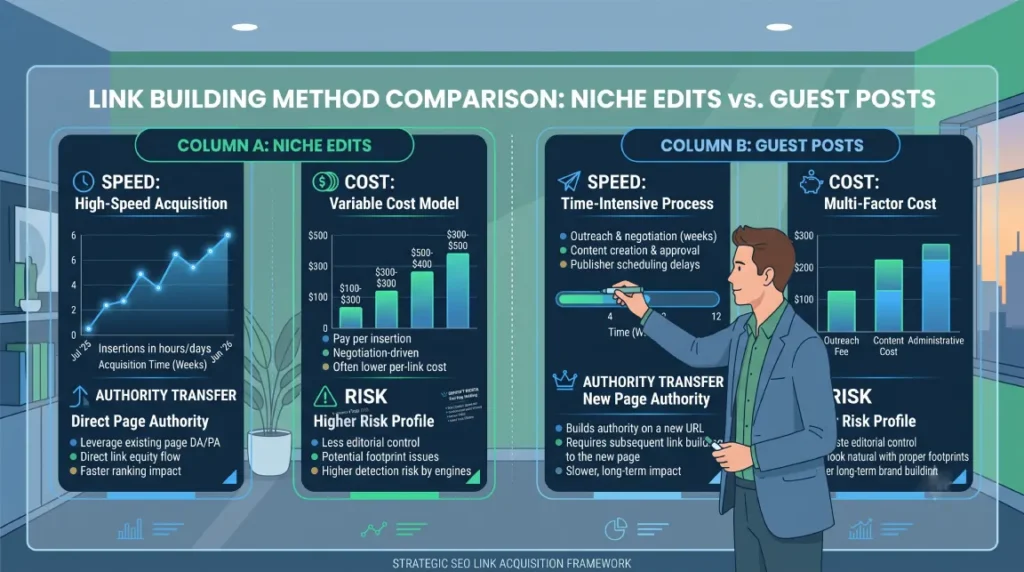
Allocate 60% of your link building budget to niche edits for speed and authority transfer. Use the remaining 40% for strategic guest posts on high-authority publications to build topical credibility and brand visibility.
Run a monthly audit using Ahrefs or Moz to track which placements are driving actual ranking changes. Drop what isn’t working within 60 days. This keeps your Backlink profiles safely multiplying over time without accumulating toxic links.
Anchor Text Balance
Vary your anchors intentionally. Use exact-match anchors sparingly (10–15% max). Fill the rest with branded, partial-match, and natural language variations. This signals organic link acquisition to Google’s algorithm.
—
For businesses that want to improve rankings without relying on risky tactics, our “Competitor Backlink Gap Analysis | Find & Win Hidden Link Opportunities” offers a structured framework based on sustainable SEO practices.
7. The Transformation: What a Smart Link Strategy Actually Looks Like
By month five, Marcus’s site had moved from page three to page one for three of his target keywords. His average traffic grew from 1,200 to 4,100 monthly sessions. He hadn’t published more blog posts. He hadn’t changed his on-page SEO. He’d simply fixed where his links were coming from and matched the right tactic to the right stage.
That’s the transformation most brands miss. They ask “which is better — niche edits or guest posts?” But the better question is “which one does my site need right now?”
The SaaS marketers, affiliate asset owners, and e-commerce store owners who win in 2026 won’t be the ones who find a single secret tactic. They’ll be the ones who treat link building as a dynamic system, not a one-time campaign.
—
If you’re ready to take the next step, our comprehensive “Identifying and Avoiding Spammy Link Networks | How to Audit Clean Backlinks” walks you through the strategies, tools, and best practices professionals use to achieve consistent organic growth.
Conclusion
Three takeaways define the niche edits vs guest post conversation heading into 2026. First, niche edits deliver speed — they leverage existing trust and pass authority faster than fresh content. Second, guest posts build brand authority — especially on selective, high-traffic publications with real editorial standards. Third, the smartest strategy combines both — with budget allocation informed by your site’s current authority level and growth stage.
Don’t treat this as an either/or choice. Treat it as a sequencing question. Start with guest posts to establish relevance, transition to niche edits to accelerate rankings, and audit your results monthly to keep compounding gains.
As search engines continue to prioritize relevance, authority, and trust, the niche edits vs guest post debate is no longer about choosing a single winner. Instead, it’s about understanding which strategy best supports your SEO objectives at different stages of your website’s growth. A thoughtful niche edits vs guest post approach helps you build a backlink profile that looks natural, diversified, and aligned with Google’s quality guidelines.
For newer websites, guest posting can be an effective way to establish topical authority, expand brand visibility, and earn contextual backlinks from relevant publications. At the same time, niche edits provide an opportunity to secure links from existing, authoritative pages that already have search engine trust. Evaluating niche edits vs guest post opportunities based on quality rather than quantity will almost always produce stronger long-term results.
The best-performing SEO campaigns rarely rely on a single tactic. Instead, they combine niche edits vs guest post strategies with content optimization, internal linking, technical SEO, and consistent authority building. This balanced approach strengthens your website’s credibility while reducing the risks associated with aggressive link-building practices.
When planning your next campaign, don’t ask whether niche edits vs guest post is universally better. Ask which option delivers the greatest value for your target pages, audience, and business goals. Every backlink should contribute to topical relevance, authority, and sustainable organic growth.
Ultimately, the niche edits vs guest post decision should be guided by data, relevance, and editorial quality—not by shortcuts or outdated SEO myths. Businesses that consistently evaluate niche edits vs guest post opportunities with a long-term perspective are far more likely to achieve stable rankings, stronger domain authority, and lasting organic visibility. As Google’s algorithms continue to evolve, investing in a strategic niche edits vs guest post framework will remain one of the smartest ways to build sustainable search performance.
Your competitors aren’t waiting. And neither should you.
Ready to stop leaving ranking power on the table?
Order our Premium Link Building Service Now (Get Now) and let our team build your organic authority engine the right way — safely, strategically, and at a scale that moves the needle.
The right strategy doesn’t just improve rankings—it builds long-term authority, trust, and sustainable organic growth. Continue exploring the resources below to strengthen every aspect of your SEO strategy.
FAQ
Q: What is the main difference between niche edits and guest posts?
A: Niche edits insert your link into an existing, already-indexed article on another site. Guest posts are brand-new articles you create and publish on third-party websites. Niche edits transfer authority faster because the host page already has trust signals built up with Google.
Q: Are niche edits safe for SEO in 2026?
A: Yes — when done correctly. Niche edits are safe as long as the host page is relevant to your niche, has real organic traffic, and the link placement reads naturally within the content. Avoid bulk insertions on low-quality sites or link farms.
Q: Can I rely on free guest posting sites for link building?
A: You can use them selectively, but they shouldn’t be your primary strategy. Free guest posting sites work best as supplementary tactics when they have editorial standards, genuine traffic, and are relevant to your industry. Using them exclusively risks pattern detection by Google.
Q: How long does it take to see results from niche edits?
A: Most niche edit campaigns begin showing ranking movement within 4–8 weeks, depending on the authority of the host site and the competitiveness of your target keywords. Some placements on very high-authority domains have shown movement in as little as 2–3 weeks.
Q: How many backlinks does a new site need before switching to niche edits?
A: There’s no universal number, but most SEOs recommend building a foundational base of 20–50 high-quality guest post links first. Once your domain has topical relevance and baseline authority established, niche edits will compound your results significantly faster.