Organic Authority Scaling Engine
Your domain is bleeding ranking power — and you might not even see it happening. B2B founders, SaaS marketers, and e-commerce store owners lose thousands in organic revenue monthly because their link profiles are either too thin, too toxic, or built with zero strategic intent.
Authority optimization isn’t a buzzword. It’s the operational backbone behind every site that climbs to page one and stays there. When your backlink profile lacks structure, diversity, and purposeful design, Google’s algorithm punishes you silently — through ranking suppression, index devaluation, and crawl budget erosion.
That’s why many businesses invest in a structured link-building service that focuses on earning high-quality, relevant backlinks instead of chasing vanity metrics or risky shortcuts.
This Authority optimization guide breaks down how to engineer a link profile that compounds in value, protects your domain, and drives measurable revenue growth without triggering penalties.
Table of Contents
- Why Most Backlink Strategies Fail Before They Start
- Authority Optimization: What It Actually Means in 2024
- Anchor Text Engineering — The Hidden Force Behind Rankings
- How to Multiply Backlink Profiles Safely at Scale
- Domain Protection: Avoiding the Penalties That Erase Rankings
Why Most Backlink Strategies Fail Before They Start
What’s the single biggest reason a well-funded SEO campaign collapses? It’s not budget. It’s not content quality either. The failure almost always lives inside the link strategy itself.
Most site owners copy what they think competitors are doing. They buy 50 links from a link farm, stuff their money keywords as anchor text, and wait. Thirty days later, Google’s Penguin algorithm flags the unnatural pattern. Rankings tank. Disavow files get submitted. Time and money vanish.
According to Ahrefs, 66.3% of pages have zero external backlinks — meaning the majority of the web is invisible to Google by default. And among those who do build links, a significant portion build them incorrectly, creating a profile that looks manipulative rather than earned.
The problem isn’t link building itself. It’s the absence of a structured authority optimization framework that accounts for link velocity, anchor diversity, source quality, and domain relevance simultaneously.
Want to understand what your rivals are actually earning? Reviewing a competitor backlink profile is often the fastest way to identify gaps your strategy is completely missing.
- Three most common failure patterns:
- Pattern 1: Over-optimized anchor text pointing to money pages
- Pattern 2: Links from irrelevant, low-authority domains with no organic traffic
- Pattern 3: Sudden link velocity spikes that trigger algorithmic filters
Want to learn more authority optimization? Our “Competitor Backlink Gap Analysis | Find & Win Hidden Link Opportunities” breaks down the process with practical examples and actionable techniques you can apply immediately.
2. Authority Optimization: What It Actually Means in 2024
“Authority” gets thrown around loosely. But authority optimization has a very specific, actionable definition — it’s the process of deliberately engineering your site’s trustworthiness signal in Google’s eyes through link quality, topical relevance, and profile consistency.
Think of it this way. Moz’s Domain Authority or Ahrefs’ Domain Rating are like a credit score. You don’t improve your credit score by opening 40 new credit cards overnight. You improve it through a history of responsible, consistent, and diverse financial behavior. Links work exactly the same way.
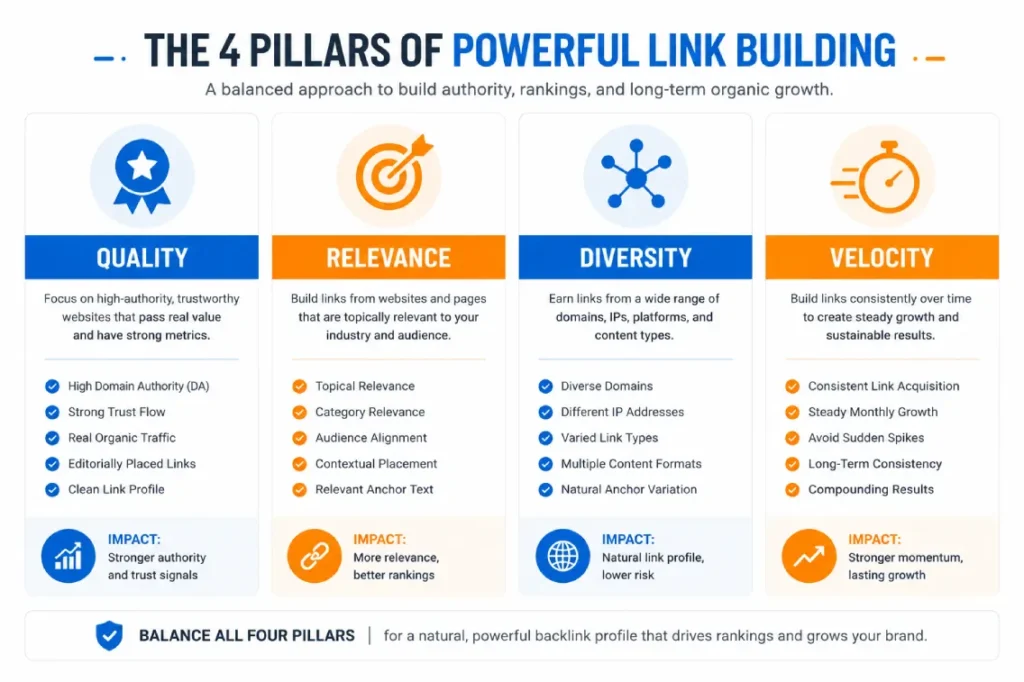
Authority optimization involves four core pillars: Link quality over link quantity — one editorial link from Forbes carries more weight than 200 directory submissions
- Topical relevance — a SaaS company getting links from cybersecurity blogs carries more contextual signal than links from recipe sites
- Profile diversity — a natural profile contains branded anchors, naked URLs, partial match terms, and generic phrases
- Link velocity control — steady, predictable link acquisition signals organic growth to Google
- So why do so few teams get this right? Because it requires patience. And most marketing teams are optimizing for short-term wins, not compound growth.
This is only one part of a successful SEO strategy. For a deeper understanding, read our “Safe Link Velocity Rules for New Websites | Link Building Guide“, which explains the complete process in detail.
3. Anchor Text Engineering — The Hidden Force Behind Rankings
Semrush data shows that sites hit by manual penalties consistently show exact-match anchor concentrations above 30%. Keep yours under 10% and you’re in a defensible position.
And remember, it’s not just what the anchor says — it’s also the surrounding paragraph text, the topical context of the linking domain, and the page’s own authority. Understanding the difference between niche edits vs guest posting strategies will also shape how you engineer anchor distribution across different link types.
Anchor text is where most link-building campaigns either win big or collapse fast. Anchor text engineering is the deliberate, calculated distribution of the exact words used in hyperlinks pointing to your site — and it’s one of the most underestimated ranking levers available.
Google reads anchor text as context. If 80% of your backlinks say “buy cheap shoes online,” the algorithm doesn’t see a trusted brand — it sees manipulation. But if your anchor text looks like what a real publication would naturally write, you build authority without red flags.
What does a healthy anchor text distribution actually look like?
Branded anchors (e.g., “Shopify,” “HubSpot”): 35–45%
- Naked URL anchors (e.g., “yourdomain.com”): 15–20%
- Generic anchors (e.g., “click here,” “this resource”): 10–15%
- Partial match (e.g., “email marketing platform for SaaS”): 15–20%
- Exact match (e.g., “best CRM software”): 5–10% maximum
The key insight is this: exact-match anchors are powerful but dangerous at high concentrations.
To explore this topic in greater depth, check out our “Modern Anchor Text Optimization Blueprint | Rank Smarter in 2026” resource, where you’ll find practical strategies, expert insights, and actionable recommendations.
4. How to Multiply Backlink Profiles Safely at Scale
Backlink profiles safely multiplying is the art of scaling link acquisition without triggering algorithmic alarms. This is where strategy separates serious operators from guesswork-driven campaigns.
Safe scaling follows a repeatable system. Here’s how it works in practice:
Step 1: Establish a baseline.
Audit clean backlinks you currently own. Identify which links are active, which are toxic, and which domains are sending the strongest signals. Tools like Ahrefs, Majestic, or Google Search Console give you this baseline within hours.
Step 2: Set a realistic velocity target.
A site earning 5 new referring domains per month shouldn’t suddenly acquire 150 in 30 days. A 20–30% monthly growth rate in referring domains is sustainable and looks organic.
Step 3: Diversify link types.
Combine editorial mentions, digital PR placements, niche-relevant guest posts, and strategic guest posting sites free in usa outreach to create a natural-looking profile mix.
Step 4: Monitor in real time.
Use Ahrefs alerts or SEMrush’s backlink audit tool to catch toxic links the moment they appear. Don’t wait for your quarterly review.
Consider the case of Canva. Their link profile grew from roughly 80,000 referring domains in 2018 to over 500,000 by 2023.
They didn’t do it by mass-purchasing links. They scaled through digital PR, free tool placements, educational content partnerships, and strategic resource page inclusions — a textbook example of backlink profiles safely multiplying over time.
5. Domain Protection: Avoiding the Penalties That Erase Rankings
Domain protection is the defensive side of authority optimization — and it’s just as important as offense. One algorithmic penalty can erase months of ranking gains in 48 hours.
Google’s Penguin update, now running in real time since 2016, continuously evaluates your backlink profile. And while it no longer requires you to wait for a refresh to recover, it also means you’re always being evaluated.
That’s not a threat — it’s a fact of modern SEO.
What are the biggest domain threats you need to actively manage?
1. Negative SEO attacks.
Competitors can (and do) point thousands of spammy links at your domain. Monitor your referring domains weekly. Disavow suspicious link clusters before they accumulate.
2. Link decay.
Research from Ahrefs shows that over 66% of links to a given page decay or disappear within nine years. This means passive link building isn’t enough — you need active link maintenance.
3. Over-reliance on a single link source.
If 70% of your links come from one type of source — say, forum profiles or sponsored posts — Google’s systems flag the pattern. Diversification protects you.
Safe link building practices aren’t just about following Google’s guidelines. They’re about building a profile that doesn’t need to be disavowed six months from now.
6. Choosing the Right Link Sources for Your Industry
Not all links are equal. And industry context changes everything. A Healthline link matters more for a medical supplement brand than a backlink from a gaming blog — even if both domains have the same DR score.
Link source selection should be driven by three filters: Topical relevance: Does the linking domain cover topics your target audience reads?
- Traffic quality: Does the domain receive real, organic search traffic? A DR 60 site with 200 monthly visitors is often worse than a DR 40 site with 40,000 monthly visitors.
- Editorial standards: Would a human editor at that publication approve this link without payment? If yes, you’re in safe territory
- For SaaS companies, Capterra, G2, Product Hunt, and niche-specific tech blogs are high-signal sources. For e-commerce brands, industry-specific publications, influencer round-ups, and comparison sites move the needle fastest.
Understanding the full spectrum of your link building services options — from editorial placements to resource pages to broken link replacements — gives you the sourcing flexibility to match link types to specific goals.
And always remember: a link from a site your customers actually read does double duty. It builds authority and drives referral traffic with purchase intent.
If you’re looking for a more detailed, step-by-step approach, our “Identifying and Avoiding Spammy Link Networks | How to Audit Clean Backlinks” guide covers everything you need to implement this strategy effectively.
7. Building a Sustainable Organic Authority optimization Engine
Authority isn’t built in a sprint. It compounds — like interest on capital. The sites dominating page one in competitive SaaS, affiliate, and e-commerce niches have one thing in common: they treat link acquisition as an ongoing operational system, not a one-time campaign.
Here’s the engine model that scales:
Monthly Editorial Targets: Set a monthly goal for referring domain growth (typically 15–25 new domains for a growing site). Assign ownership to a specific team member or agency.
Content-Led Link Magnets: Create one or two “linkable assets” per quarter — original research, free tools, comprehensive industry reports. HubSpot’s State of Marketing report earns hundreds of links annually without any active outreach.
Relationship-Based Outreach: Build relationships with editors, journalists, and site owners in your space. A warm email from a known contact converts at 5–10x the rate of cold outreach.
Quarterly Profile Audits: Every 90 days, run a full audit clean backlinks review. Prune toxic links, refresh broken placements, and adjust your anchor text distribution.
This isn’t guesswork. It’s a repeatable system for authority optimization that compounds quarter over quarter, building the kind of domain strength that withstands algorithm updates, competitors’ attacks, and market shifts alike.
If you’re ready to take the next step, our comprehensive “Niche Edits vs Guest Post: The Winning Link Building Strategy for 2026” walks you through the strategies, tools, and best practices professionals use to achieve consistent organic growth.
Three Takeaways and Your Next Move
Authority optimization is a long-term asset, not a short-term tactic. Your backlink profile either works for you or against you — and there’s no neutral middle ground.
Here are your three core takeaways: Engineer your anchor text deliberately. Distribution matters more than individual link quality in many cases.
- Scale link velocity sustainably. Fast spikes attract penalties; steady growth builds compound authority.
- Protect your domain actively. Monitor, disavow, and audit regularly — domain protection is ongoing, not reactive.
The brands winning organic search in 2024 treat link building as a strategic operation, not a checkbox task. And that operation requires expertise, systems, and the right partners.
Ready to stop leaving ranking power on the table? Order our Premium Link Building Service Now (Get Now) and let our team build your organic authority engine the right way — safely, strategically, and at a scale that moves the needle.
The most successful websites don’t rely on luck—they rely on strategic decisions backed by data, consistency, and a long-term SEO vision. Keep exploring our expert resources to stay ahead of the competition.
FAQ
Q: What is authority optimization in SEO?
A: Authority optimization is the strategic process of building and managing your site’s backlink profile to signal trustworthiness and topical expertise to search engines. It involves controlling link quality, anchor text distribution, link velocity, and source relevance to compound ranking power over time without triggering algorithmic penalties.
Q: How can I safely multiply my backlink profile without risking a Google penalty?
A: Safe scaling requires four steps: auditing your current profile, setting a sustainable velocity target (15–30% monthly referring domain growth), diversifying link types (guest posts, editorial mentions, niche edits, PR), and monitoring for toxic links in real time. Avoiding sudden spikes and maintaining diverse anchor text distribution are the two most important protective factors.
Q: What is anchor text engineering and why does it matter?
A: Anchor text engineering is the deliberate distribution of the words used in hyperlinks pointing to your site. A natural profile balances branded anchors (35–45%), naked URLs (15–20%), partial match terms (15–20%), generic phrases (10–15%), and exact-match keywords (5–10% maximum). Concentrations of exact-match anchors above 30% are consistently linked to manual penalties.
Q: How do I protect my domain from negative SEO attacks?
A: Monitor your referring domains weekly using tools like Ahrefs or Google Search Console. When you identify clusters of spammy or irrelevant links pointing to your site, create a disavow file and submit it through Google Search Console promptly. Don’t wait for rankings to drop — proactive monitoring is your best defense.
Q: What’s the difference between guest posting and niche edits for link building?
A: Guest posting involves writing a new article published on another site with a link back to your domain — giving you full control over content and context. Niche edits (also called curated links) involve inserting a link into an existing, already-indexed article on a relevant site. Niche edits often carry faster authority signals because the page already has established history, while guest posts give you more content control and branding opportunity.