
Generative Engine Optimisation: Content Architecture for AI (chatgpt and deepseek)
The digital discovery landscape is undergoing a permanent structural shift. Generative Engine Optimisation (GEO) has emerged as the necessary evolution of search engine visibility, moving beyond traditional keyword tracking into direct optimisation for large language models (LLMs).
With engines like DeepSeek and ChatGPT capturing massive market share for informational queries, websites must adapt to synthetic search behaviours. Traditional SEO strategies designed for static indexes will not survive this transition.
Achieving high visibility in generative outputs requires a fundamental re-engineering of how data is structured, parsed, and ingested by web crawlers.
What Is Generative Engine Optimisation?
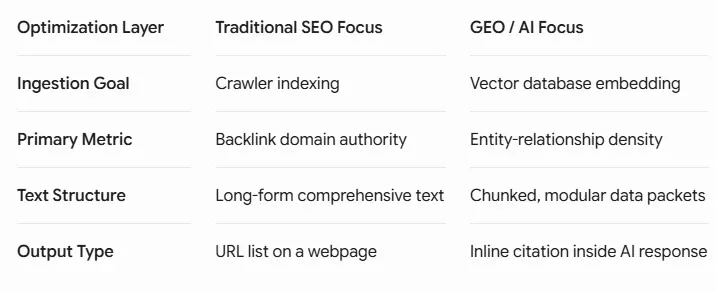
Generative Engine Optimisation (GEO) is the technical process of structuring digital content to maximise its retrieval, comprehension, and citation probability by generative AI search models.
Unlike traditional SEO, which optimises for indexing algorithms and click-through rates on search engine result pages (SERPs), GEO optimises for vector embeddings, semantic relevance, and retrieval-augmented generation (RAG) pipelines.
Key Insight: Traditional search engines rank websites based on link equity and keyword density. Generative search engines select sources based on informational density, architectural clarity, and direct context matching.
The Core Mechanics of AI Search Engine Visibility
To rank content within an AI-generated answer, you must first understand how models ingest web data. The retrieval workflow determines what data gets summarised and what gets ignored.
Semantic Chunking and Parsing
AI scrapers do not read entire pages as a single text block. They segment content into localised nodes based on contextual changes.
If your sentences are overly long or lack explicit topical markers, the parser splits the context incorrectly. This reduces the semantic weight of the text during the model’s retrieval phase.
Vector Embeddings and Similarity Scoring
When a user submits a prompt to DeepSeek or ChatGPT, the engine converts that query into a mathematical vector representation.
The engine then searches its database for content chunks with the closest vector distance. Websites that present direct, authoritative concepts score higher in cosine similarity matrix calculations, ensuring selection.
Designing a Chunk-Based Content Strategy
An optimised GEO strategy for 2026 relies on modular layout frameworks. Content must be written in distinct, self-contained blocks that retain absolute meaning even when extracted independently from the page.
Enforcing the 3-Line Text Rule
Long walls of text cause dilution during the vector encoding process. Limit all paragraphs to a maximum of three lines.
Breaking paragraphs forces the writer to eliminate linguistic padding. It creates hyper-focused information blocks that match the extraction patterns of RAG data splitters perfectly.
Single-Idea Node Architecture
Each text node must focus on a solitary technical concept. Do not mix disparate industry ideas within the same subsection.
If an article switches from defining an acronym to explaining its deployment within the same paragraph, the mathematical clarity of that chunk drops significantly.
Deploying Semantic Markup for LLMs
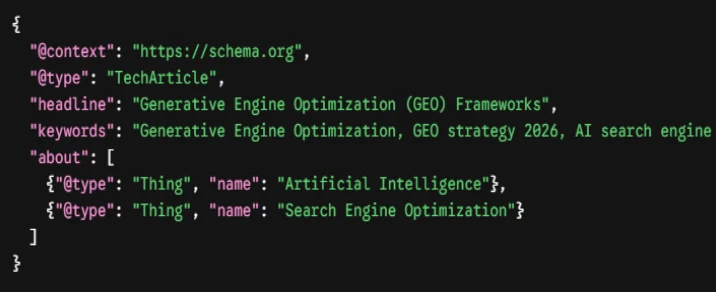
Semantic markup for LLMs refers to the implementation of clean HTML hierarchies and schema structures that allow AI models to instantly categorise the entities present on a webpage.
By utilising precise tagging, you remove ambient noise from the page code, making it easier for automated scrapers to identify core technical documentation.
Strategic Heading Implementation
Maintain a rigid layout hierarchy. Use only one H1 tag per document, followed by systematic H2 and H3 placements.
Headings must contain direct noun phrases. Avoid creative or metaphorical titles, as generative models process literal entity relationships rather than stylistic wordplay.
Optimizing for DeepSeek
Optimising for DeepSeek requires formatting data to align with deep-reasoning verification pathways and cost-efficient extraction models.
Because DeepSeek models employ specialised architectural pipelines optimised for processing code, structured tables, and analytical proof points, the content must prioritise empirical data over descriptive text.
- Integrate Structured Markdown Tables: DeepSeek architectures parse structured Markdown datasets with high precision, pulling direct values into comparative summaries.
- Prioritise Direct Technical Definitions: The open-source model filters out subjective adjectives. Use technical vocabulary to retain vector proximity to programmatic industry documentation.
- Deploy Validated Code Snippets: If your content discusses deployment frameworks (such as configuring React.js or Tailwind CSS), provide raw code blocks with explicit commentary tags.
Optimizing for ChatGPT
Optimising for ChatGPT involves aligning content with multimodal retrieval models that value conversational authority, executive depth, and direct problem-solving frameworks.
OpenAI platforms utilise broad semantic synthesis layers, meaning they require explicit entity connections to map your brand to specific industry niches.
- Execute the Answer-First Format: Provide immediate definitions directly below headings to satisfy ChatGPT’s rapid-extraction criteria.
- Build Clear Internal Linking Webs: ChatGPT’s browsing agents crawl related internal assets to verify the topical boundaries of a domain.
- Explicitly Reference Core Entities: Clearly connect your main services to globally recognised industry standard terms within Wikidata contexts.
The Advanced GEO Framework (The A-G-E-O Model)
To guarantee consistent discovery across generative engines, integrate the four pillars of the advanced A-G-E-O architectural model.
A — Atomic Information Density
Content must contain real-world parameters, explicit metrics, and objective data points. Eliminate all generic summaries and introductory filler material.
G — Graph Semantics
Connect technical terms explicitly. Define the exact relationships between different elements so that LLM relation-extraction algorithms map your site as a primary source node.
E — Extraction-Friendly Interface
Utilise structured lists, numbered execution paths, and distinct data tables. Layout variations prevent model extraction timeouts during web aggregation phases.
O — Output Symmetry
Format your webpage layouts to match the exact syntax structures generated by LLMs. Writing responses in the direct style used by the engines creates frictionless source matching.
In The End
Generative engine optimisation is no longer an experimental approach; it is the baseline requirement for digital discovery in 2026. Websites that rely exclusively on legacy SEO protocols will face a catastrophic decline in organic footprint as consumer behaviours pivot toward interactive AI interfaces.
By treating content as an interconnected system of clean, semantically marked data packets, you position your brand assets to serve as the foundational training data and active citation points for the world’s leading generative models.